
The Data
The case for fewer meetings isn’t an opinion.
The data is ugly.
For years, meetings have been treated as an unavoidable part of work.
The research tells a different story.
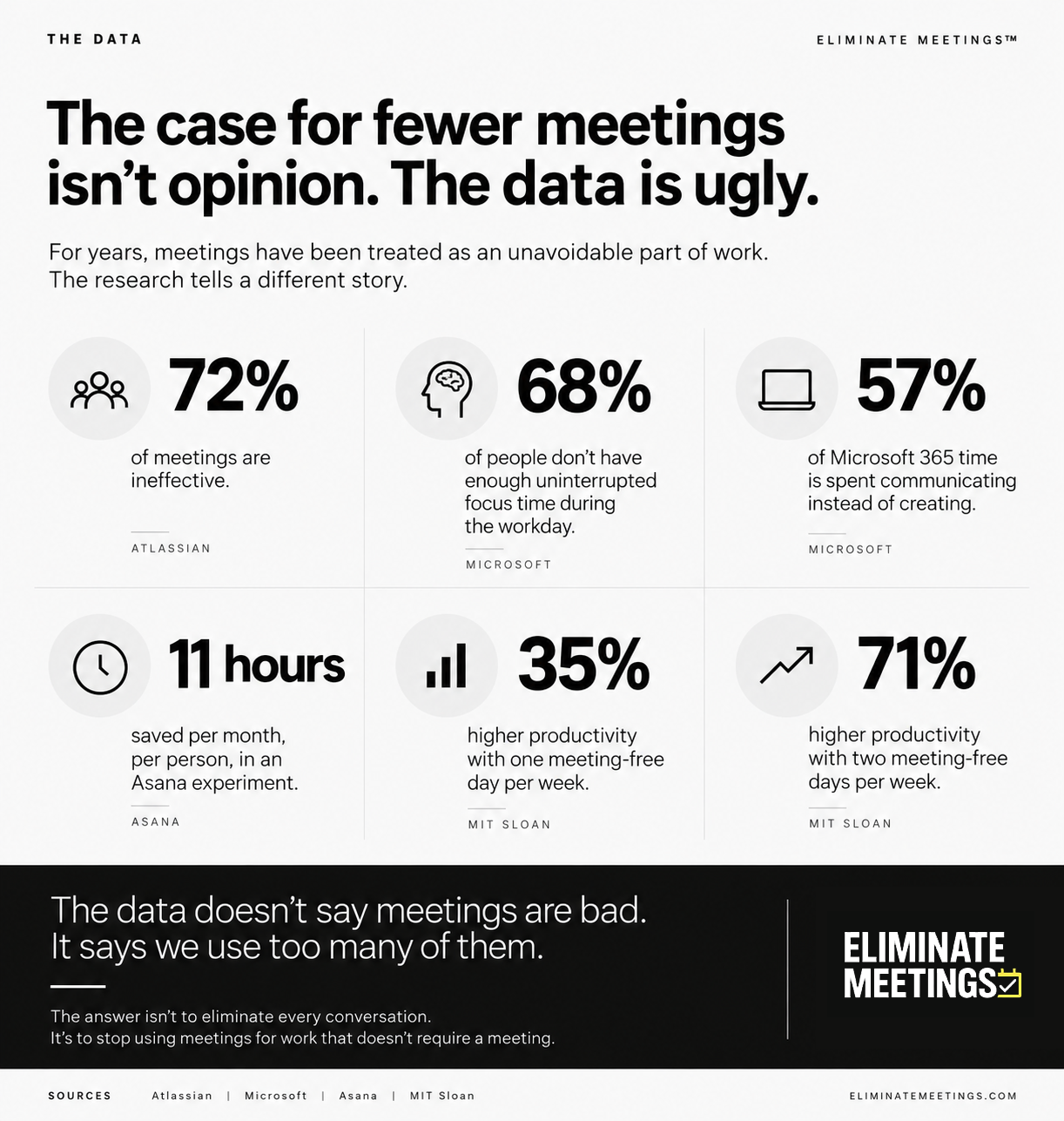
72% of meetings are ineffective.
(Atlassian)
Atlassian’s research found that meetings are ineffective 72% of the time. People reported unclear next steps, repetitive information, and meetings that could have been handled another way.
68% of people don’t have enough uninterrupted focus time during the workday.
(Microsoft)
Microsoft found that 68% of people don’t have enough uninterrupted focus time. The workday is increasingly consumed by communication, leaving less room for the focused work people are actually employed to do.
57% of Microsoft 365 time is spent communicating instead of creating.
(Microsoft)
Meetings, email, and chat account for 57% of the average employee’s time in Microsoft 365. Only 43% is spent creating in documents, spreadsheets, and presentations.
11 hours saved per month, per person.
(Asana)
In a recent Asana experiment, employees redesigned their meetings and eliminated meetings that were no longer productive. Participants saved an average of 11 hours per month.
35% higher productivity with one meeting-free day per week.
(Microsoft)
Research involving 76 companies found that productivity increased 35% when organizations introduced one meeting-free day each week.
71% higher productivity with two meeting-free days per week.
(Microsoft)
The same research found that productivity increased 71% when organizations introduced two meeting-free days each week. Employees also reported greater autonomy and satisfaction.